

Where Loss Met Purpose: My Journey at Milton Hershey School
By Princess Tommy ’26
My life has always felt like a ticking clock, steady and constant. Before I ever stepped onto campus, my small household of three, my mother, my sister, and I, were struggling to stay afloat. I remember worrying quietly about things I was too young to fully understand but old enough to feel.
Tick.
When my sister moved out, launching her life after college, it was just my mother and me. The clock never stopped; it simply kept moving, teaching me how to move with it.
Like the family of so many others of my peers, my mother worked tirelessly to provide for me. She kept her standards high. She made sure I felt rich in love, stability, and opportunity.
At the end of one of my mother’s perfectly sculpted days, I was lying in the bed we shared. She was asleep beside me, snoring in a steady rhythm, while I stayed up late, as usual, watching Jessie on Disney Channel, afraid of the dark and only comforted by the glow of the TV.
When the bedroom door slowly opened, I didn’t think much of it. The mysterious sounds of Yeadon, Pennsylvania, had never shaken the confidence of a six-year-old who thought this was just another ordinary night. But it wasn’t ordinary.
A man I had never seen before stood in our doorway, pointing a gun at my head.
The laughter from Jessie, the lives I wished were mine, faded into nothing but static. Before I could even process what was happening, the pieces of my “perfect” world were quite literally being taken from us.
The robbery was quick, and the only thing left was our lives.
Tick.
The months that followed were filled with turmoil until one day my mother asked me a question: “Would you want to go to MHS?” Between the sweetness of the word “chocolate” and the quiet desire to follow in my older sister’s footsteps, watching how the school provided her with a college education and extracurriculars like sports, I said yes, not knowing how much one decision would change my life.
At MHS, I constantly challenged myself to stay focused. Coming to MHS as a kid still attached to my mother’s hip, a separation quickly caused me to become what society would call a “problem child.” A consistent list of chores and consequences became my norm. In middle school, my mother had started to travel several times a year, in and out of the country, making me crave stability. I was barely hanging on. My houseparents helped calm the storm, instead of rushing to punish me when I lashed out or argued, they allowed me to talk through my frustration, teaching me that patience and time are better than unchecked judgment. This helped me keep my character morally straight.
Nevertheless, all the work I had done was eventually put to the test. In high school, my mother began to develop serious health issues, and with each new diagnosis, my pledge to high standards started to slip.
By my junior year, her health took a devastating turn. She suffered three strokes, losing both her mobility and her ability to speak.
Tick.
I was reminded that the clock was always going to follow me. I threw myself into school and extracurriculars, using achievements as motivation— and as a mask. I convinced myself, that if I worked harder, she would get better. And for a moment, I felt like it worked.
By the summer before my senior year, she had regained her ability to walk and speak. It felt like the clock had finally found its steady pace again.
But some clocks aren’t meant to tick forever. At the start of my senior year, following a phone call from my brother, the clock started its strange tick again.
My mother was diagnosed with stage 4 cervical cancer. The doctors told me and my siblings that she had two to three months to live.
Tick.
My senior year. The year that was supposed to be the start of new beginnings, instead, it was the conclusion of hers.
Just after getting that call from my brother, the clock ran out on August 31st, and my mother took her last breath. I didn’t get two to three months; I got just two weeks, and my whole world turned upside down again.
Tick.
Even saying it now feels like I’m dreaming.
I thought the clock in my life was counting down, ticking toward loss, toward endings, toward tragedy. Today, however, I know the clock doesn’t always signal the end of your story. Sometimes it signals the beginning of who you are becoming. For me, it’s being a part of the class of 2030 at Temple University studying Film and Television. Because of MHS, I will be taking my high standards, all the opportunities, my work ethic, and lessons with me. And because of that, I am certain of my future.
When my world fell apart, I did not crash. My teachers, my houseparents, and the adults who saw me on my hardest days still saw potential. People like Mr. Karavage, who was my first call after my loss, and Mrs. McElwain, who guided me through my transition back onto campus.
MHS did more than educate me. It steadied the ticking clock. It reminded me that even when time feels cruel, it is also shaping you. It turned my story from something fragile into something forged.
My mother’s time in my story may have ended, but mine did not. And neither has yours.
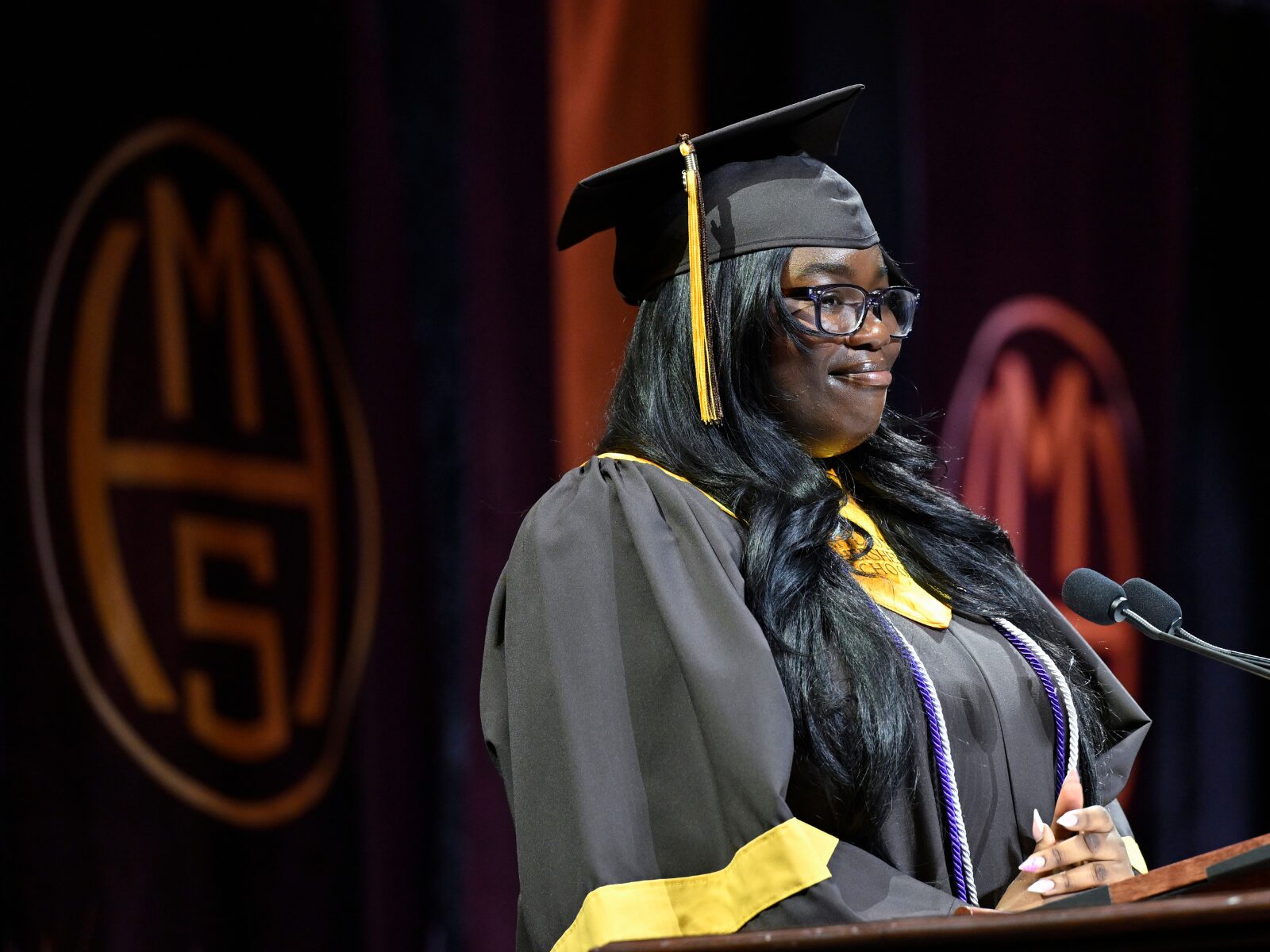
I stand before you as one member of the Senior Class, a class that represents perseverance. We must choose to rise in all the moments that try to break us. We cannot let them define us. Let your life become proof that pain is not the end of the story.
Today is not the end of an era. It is the coming of a renaissance. The clock is still ticking, not as a countdown, but as a reminder that our time is precious, purposeful, and powerful.
And for the Class of 2026, the clock is still ticking. And for the first time, we are not listening for what it might take away. We are listening for all that it still has to give.
And we will not let it tick quietly.
Learn More about the Class of 2026