

Looking Back at Milton Hershey School’s Bicentennial Celebration
As the United States celebrates its 250th anniversary, it is fitting to look back on an earlier milestone—the United States Bicentennial in 1976—when communities across the country marked it with pride and reflection. At Milton Hershey School, the 200th anniversary of American independence became far more than a national observance; it was a yearlong, school-wide effort to connect students with history, heritage, and the enduring values that shaped both the nation and the institution itself.
The spirit of the Bicentennial at MHS began even before 1976 officially arrived. During Founders Week in November 1975, the school introduced the Milton Hershey School Bicentennial Color Guard, a group that would become a centerpiece of the celebration. Their performances blended history, discipline, and theatrical storytelling.
One of the most memorable moments occurred when the Bicentennial Color Guard, dressed in their colonial uniforms, performed at the William Penn Museum plaza before the Liberty Bell replica. This performance featured two performed pieces titled “I Am Old Glory” and “Listen to the Drumbeats of Freedom” supported by a multimedia display highlighted by a stunning 45-foot American flag. Under the instruction of Colonel William Prescott, a retired Army officer turned teacher, the students mastered the Revolutionary War manual of arms, bringing authenticity and precision to their performances. According to The Patriot-News, the audience was so deeply moved that they refrained from applauding, feeling that silence was the most respectful response.
The Bicentennial was not only commemorative—it was interactive. Students participated in an essay contest sponsored by the English department titled “America: 200 Years of Revolution.” The contest encouraged reflection on the nation’s journey and ideals. One winner from each Senior Division grade level and their essays were published in our school newsletters. The winners were Kenny Wilder ’77, Dan Stewart ’78, Keith Cavanaugh ’79, and Jeff Kephart ’80. Their essays brought a range of thoughtful insights into the American experience for all.
Across campus, departments contributed to a shared historical narrative through display cases representing different aspects of American history. The English department highlighted the thirteen original colonies, while the science department explored the evolution of apothecaries in early America. Even the school’s yearbook embraced the theme, weaving Bicentennial imagery and storytelling throughout its pages.
Meanwhile, creativity flourished as the print shop produced Bicentennial stickers featuring a student-designed logo, while art teacher Clyde Stacks created a large mural depicting the whole of American history. These efforts transformed the campus into a living exhibition of the past.
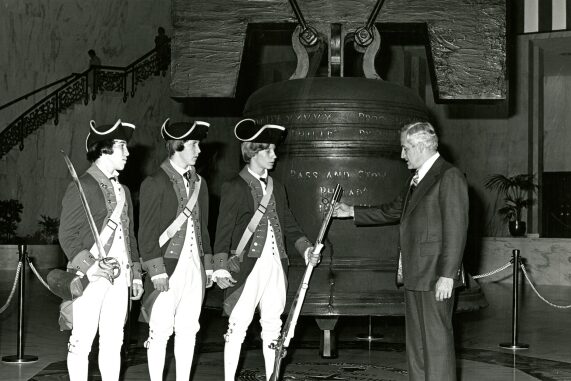
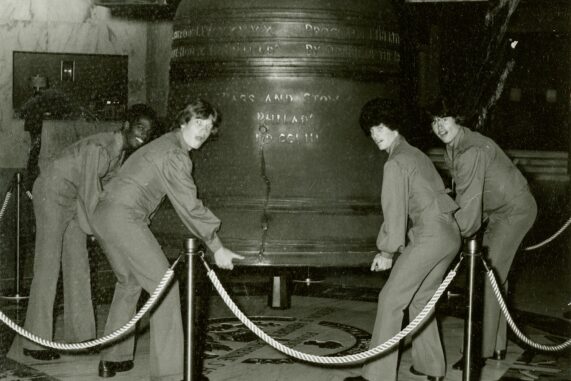
A particularly powerful element of the commemoration was the presence of a replica Liberty Bell and a Betsy Ross flag, both displayed prominently at Founders Hall as symbols of freedom and perseverance. These artifacts served as daily reminders of the sacrifices made two centuries earlier.
Central to the Bicentennial reflections at MHS was the recognition of Milton Hershey himself as a figure who embodied the same ideals that inspired the nation’s founders. His life, marked by perseverance and generosity, echoed the principles of life, liberty, and the pursuit of happiness.
Just as the founders risked everything to establish a new nation, Mr. Hershey overcame setbacks to build a legacy grounded in opportunity and care for others. His creation of Milton Hershey School stood as a testament to the belief that individual determination could uplift entire communities.
All of these activities combined were designed to instill what organizers called the “spirit of ’76.” Yet, as school leaders noted at the time, that spirit could not simply be created through events; it had to be embraced individually. Each student and teacher was encouraged to find their own connection to the ideals of freedom, responsibility, and perseverance.
With cooperation and enthusiasm across campus, 1976 became a defining year at MHS—a moment when history was not only studied but lived.
Now, fifty years later, as we reflect during America’s 250th anniversary, the Bicentennial celebration at MHS stands as a vivid example of how a community can honor history while inspiring the future. Through creativity, scholarship, and shared purpose, students and faculty alike succeeded in bringing the past to life and, in doing so, strengthened their connection to the enduring ideals that continue to shape both the nation and the school today.
Read More Historical Blogs