

The Harmony I Found at Milton Hershey School
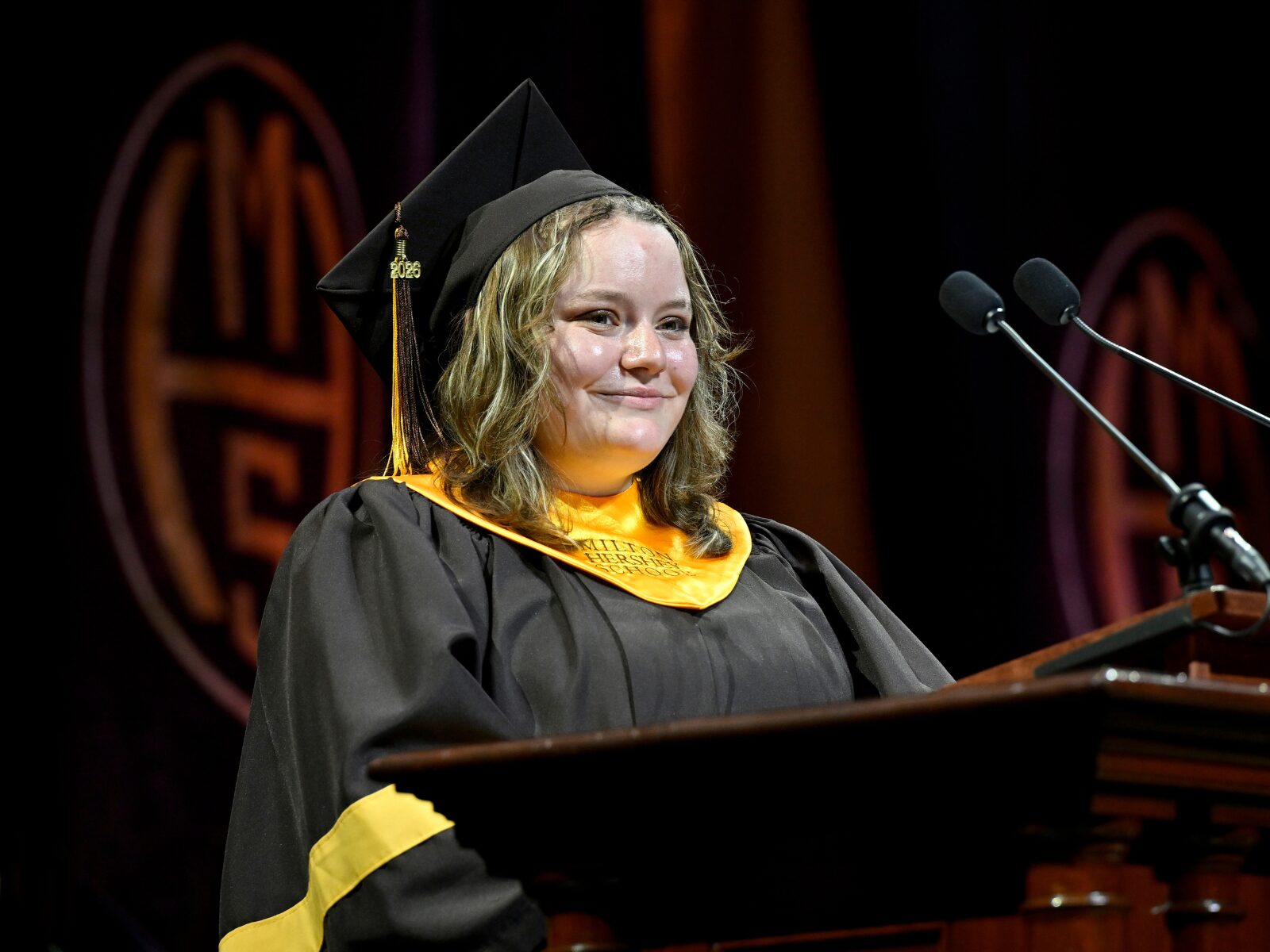
By Layla Wright ’26
At four years old, I didn’t know the words of Our Pledge. But I knew what they meant.
Every night, I waited for my mom to come home after twelve hours of working on her feet.
Instead of collapsing, she would turn up Sia’s “Cheap Thrills” and break into song, singing “Baby, I don’t need dollar bills to have fun tonight.”
She’d grab my hand to revive the child inside of me, a little girl already exhausted from witnessing and experiencing things no child should at such a young age.
My childhood was a blur of more houses and strangers than Sesame Street could ever teach me to count, moving from house to house just to keep a roof over our heads.
Yet, my mind doesn’t gravitate towards the violence that broke my mother’s nose, or the piercing sound of her screams mixed with my brother’s cries. She was willing to suffer ten times more just so we could have the semblance of a normal childhood.
Instead, I remember her on her knees, and me running my fingers through her red-brown hair and along the stitches on her face, imagining those bumps were like plucking each string on my grandpa’s guitar.
Tracing her face was the first time I realized she wasn’t just a DJ playing a track so we could dance—she was carrying the world on her shoulders.
Through those small moments, a piece of my childhood innocence stayed behind: in our tiny apartment, we danced barefoot on cracked linoleum, laughing like we had it all. The hum of the refrigerator and the slap of our feet on that cold floor were our orchestra—an unforgiving lesson that strength is finding joy even when the world has nothing left to give.
But if my mother was the song, my father was the silence between the notes. He fought addiction, heartbreak, and poverty, but he still believed in music—and in me.
Sometimes, I think Eminem’s “Mockingbird,” one of his favorite songs, was written for him when he says, “Stiffen up that upper lip, little lady, I told you, / Daddy’s here to hold you through the night.”
My father wasn’t there physically, but his unspoken promises lived between the lyrics he loved—his way of using someone else’s words to promise the stability he couldn’t give. Translating his raw, unfinished chords taught me to build a fortress around my heart, suppress my fear, and rely completely on myself.
I brought that same armor with me when I first arrived at MHS. Before, at public school, I was known as the poor, chubby, dirty girl without a dad. In my loneliness, I thought I could still do something worthwhile—mean something—if I just kept my head down and did my schoolwork. I thrived on academic validation because if I wasn’t the smartest, I was nothing.
My father passed away during my first year here at MHS—I was just 16, and he was 41. I began to be crushed in the fortress I built, leaving only the deafening ring of silence in my ears.
But Our Pledge and the people it built wouldn’t let me stay in that silence. It whispered: Keep yourself physically strong, mentally awake, and morally straight.
So, I did. Music became my survival. My teachers saw a spark I couldn’t see; my friends stood beside me. I broke down in the arms of my housedad who—by some quiet, bittersweet irony—shared my father’s exact last name.
He held me with the steadiness the blurred faces of my childhood could never give. Where most men in my life brought chaos, my housedad, Andrew Wright, became the steady beat that I thought only existed in music.
In student home Wyandot, the missing notes of my family’s melody were finally filled in. Our Pledge wasn’t just words—it was a community refusing to let each other fall.
Driven by that pulse, I threw myself into any type of music I could get my hands on—marching band, indoor percussion, pit orchestra, and more—needing the sweat, rhythm, and faith of performance. It taught me art isn’t about perfection, it’s about connection.
It let me finally realize that there was more to me than just my brain, that even though at home society viewed me as a burden, at MHS I could simply “be” and that was enough. I didn’t have to prove that I had a reason for existing through academic work: at MHS, I felt each piece of armor cracking with each note that resonated through the instruments I played. I made friends, mentored younger students, and finally gave up on perfection, as music had taught me that wrong notes could still lead to harmony.
The echo of every performance’s final note felt like the voices of all of those who pushed me, urging me to keep going. And when I stood in Panamá, translating for people whose stories mirrored my own, I finally understood the final line of Our Pledge: To do all I can for the good of my school, my country, and my God, because courage isn’t about forgetting pain — it’s about transforming it into purpose.
Sometimes, I think Our Pledge was written for kids like me—the ones who grew up between love and loss; learning honor isn’t recognition—it’s resilience.
My father gave me the melody, my mother taught me to dance to it, and MHS—the students, the teachers, the houseparents—gave me the harmony to carry me forward.
I stand here not as someone who had an easy life, but as someone who found her purpose in pain, her strength in sound, and her courage in the choir who refused to let me walk alone.
Because Our Pledge isn’t just something we recite: It’s something we live. Sometimes it’s the only thing that teaches us how to keep singing when the music stops; a constant hum of hope that refuses to die.
My time here has come to an end. But you, Spartans, still have the power to take the pain that was thrust upon you and transform it into something breathtaking.
I could have stayed complacent—allowed myself to accept that I would never be anything more than what I was born into: homelessness, drugs, abuse, and isolation.
But MHS, its community, and Our Pledge taught me the most important words I know that I leave you all with: survival is not the end of the story, but the beginning of who we choose to become.
Learn More about the Class of 2026